
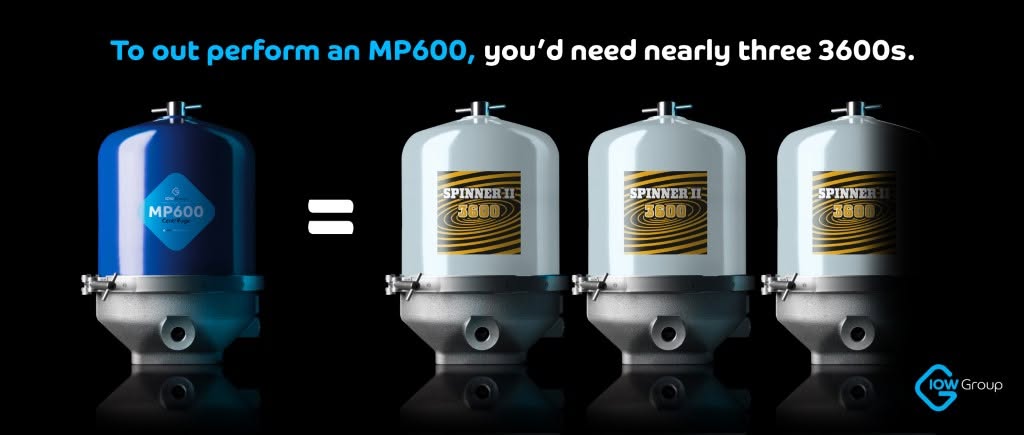
Maintaining clean lubricating oil is essential for protecting engines, improving reliability and reducing maintenance costs. Whether operating marine vessels, industrial machinery or power generation equipment, contamination within the lubrication system can significantly affect performance and equipment lifespan. Centrifugal oil filtration has long been used to remove harmful particles from lubricating oil. Systems such as the Spinner II oil cleaning centrifuge provide an additional level of protection alongside conventional full-flow filters, helping control contamination that might otherwise remain circulating through the engine.
However, advances in centrifugal filtration technology have introduced new opportunities to improve oil cleanliness and reduce maintenance requirements. IOW Group centrifugal oil filters incorporate patented disc-stack technology, a sealed bowl and remote monitoring as standard, offering operators an advanced alternative to traditional pressure-driven centrifuges. So, how does Spinner II technology work, and what are the benefits of upgrading?
What is a Spinner II Centrifugal Oil Separator?
Spinner II is a range of pressure-driven centrifugal oil cleaners designed to remove solid contamination from lubricating oils and other suitable industrial fluids. These centrifuges use centrifugal force rather than disposable filtration media to separate particles from oil. Typically installed as bypass filtration systems, they process a proportion of the circulating oil while the engine’s main lubrication system continues operating.
Spinner II centrifuges are commonly associated with applications involving diesel engines, industrial machinery and equipment where contamination control is essential. Their purpose is to reduce the concentration of soot, dirt, metallic particles and sludge that can contribute to premature component wear.
How Does a Spinner II Centrifugal Oil Separator Work?
A Spinner II centrifuge uses oil pressure to generate the rotational force required for separation. Contaminated oil enters the unit through a central spindle before passing into the rotor. As oil exits through specially positioned nozzles, the resulting reaction force causes the rotor to spin rapidly. This rotation generates centrifugal force, pushing denser contaminants towards the outer wall of the bowl.
Over time, these particles accumulate and form a layer of sludge that can be removed during servicing. The processed oil then returns to the engine’s crankcase or oil reservoir, allowing the cleaning process to continue. Unlike conventional barrier filters, centrifugal oil cleaners do not rely on fine filtration media that gradually becomes restricted as contamination accumulates. Instead, collected solids remain inside the rotor until maintenance is required.
Why is Centrifugal Oil Separation Important?
Lubricating oil performs several critical functions, including reducing friction, transferring heat and protecting moving components against wear. However, during normal operation, contaminants can enter the lubrication system through combustion processes, component wear and environmental exposure.
If these particles remain circulating, they may contribute to:
Increased abrasive wear
Sludge and deposit formation
Reduced lubricant effectiveness
Shorter primary filter service intervals
Increased maintenance requirements
Unplanned equipment downtime
Conventional full-flow filters provide essential protection, but their filtration capabilities must be balanced against the engine’s need for continuous oil flow. Consequently, some fine contamination may pass through the primary filtration system. Centrifugal oil filters provide supplementary cleaning by targeting particles that may otherwise remain suspended within the oil. This makes them particularly useful in applications where soot and fine particle contamination are ongoing concerns.
What Are the Benefits of Centrifugal Oil Cleaners?
Installing an effective centrifugal oil filtration system can deliver several operational advantages.
Improved Engine Protection
Removing abrasive particles reduces the amount of contamination circulating around critical engine components. Maintaining cleaner oil helps protect bearings, cylinder components and other lubricated surfaces against contamination-related wear.
Extended Oil Service Intervals
Effective filtration can help maintain lubricant cleanliness, potentially supporting longer oil-change intervals. However, any extension should be supported by oil analysis and the relevant equipment manufacturer’s recommendations.
Reduced Maintenance Costs
Cleaner oil can help reduce contamination-related wear and support longer primary filter service life. This may lower expenditure on replacement components, consumables and maintenance labor.
Improved Equipment Reliability
Contamination is a contributing factor in many lubrication-related equipment problems. By controlling soot, sludge and metallic particles, centrifugal filtration helps reduce one of the risks associated with premature machinery failure.
Reduced Oil Waste
Extending lubricant service intervals can reduce the volume of waste oil requiring disposal. Centrifugal filtration also offers the advantage of collecting contamination within a serviceable bowl, reducing reliance on disposable fine-filter cartridges.
Spinner II vs IOW Group: What's the Difference?
Although Spinner II and IOW Group centrifugal oil separators use the same fundamental separation principle, their internal technologies differ. IOW Group has developed its centrifuges to improve contaminant removal and provide greater visibility of filtration performance. Several features distinguish IOW Group’s technology from traditional centrifugal oil cleaners.
1. Patented Disc-Stack Technology
One of the most significant differences is IOW Group’s patented disc-stack bowl design. Traditional pressure-driven centrifuges primarily rely on contaminants travelling towards the outer wall of the rotating rotor. IOW Group incorporates a series of discs within the centrifuge bowl, increasing the effective separation surface area. This reduces the distance particles need to travel before separation, helping improve the removal of fine soot, sludge and other contaminants. The disc-stack arrangement is particularly beneficial in applications where effective removal of fine particles is essential.
2. High-Speed Centrifugal Separation
Rotational speed is an important factor in centrifugal filtration performance. As centrifuge RPM increases, the centrifugal force generated also increases, helping denser contaminants separate from the oil. IOW Group’s internal design is engineered to achieve effective rotational speeds and separation performance using the available oil pressure. The distributor impeller supports oil movement through the centrifuge while helping minimize backpressure. However, filtration efficiency depends on several factors, including oil viscosity, flow rate, contaminant characteristics and centrifuge design, rather than rotational speed alone.
3. Fully Sealed Bowl Design
IOW Group centrifugal oil filters feature a sealed bowl designed to help keep collected contamination contained. This reduces the risk of accumulated sludge being disturbed and re-entering the lubrication system during servicing. The design also supports a cleaner and more straightforward maintenance process.
4. Remote Monitoring as Standard
Another advantage of IOW Group centrifugal oil filters is their integrated monitoring capability. The CentriClean Speed Control Unit (SCU) monitors centrifuge RPM, providing operators with useful information about operating performance. As contamination accumulates within the bowl, rotational speed may decrease, indicating that servicing is required. This helps engineers make more informed maintenance decisions instead of relying solely on fixed servicing schedules. For businesses managing multiple engines or machinery, remote monitoring can support more efficient maintenance planning.
Can You Replace a Spinner II Centrifuge with an IOW Group Filter?
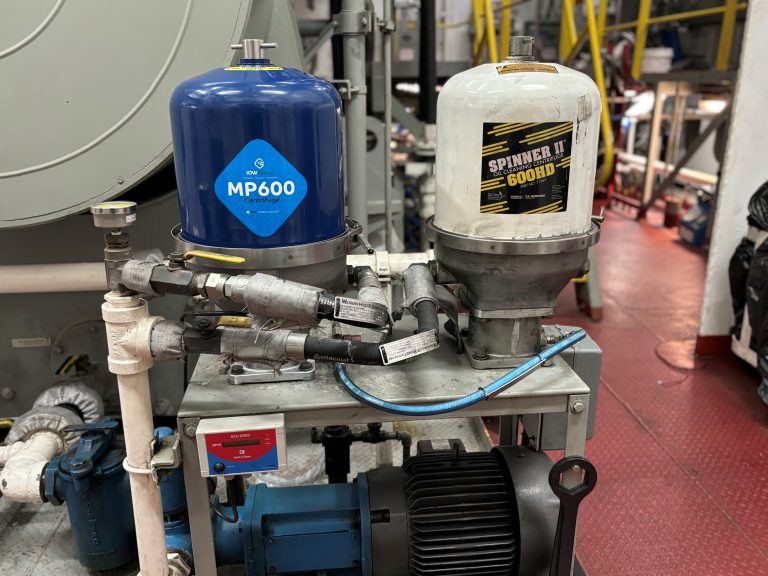
For operators already using Spinner II centrifugal oil cleaners, upgrading to IOW Group technology may be straightforward. IOW Group’s MP centrifugal oil separator range has been developed with retrofit compatibility in mind. Certain models feature mounting arrangements and connection configurations suitable for replacing existing centrifugal separators without extensive system modifications. This bolt-off, bolt-on approach can help minimize installation time and disruption. However, the appropriate replacement must be selected according to the existing centrifuge and lubrication system requirements. Operating pressure, available oil flow, sump capacity and oil return arrangements should all be assessed before installation.
Why Choose IOW Group Centrifugal Oil Filters?
IOW Group offers a range of pressure-driven centrifugal oil filters designed for different engine sizes and applications. The MP Series includes the MP090, MP200, MP400, and MP600, providing solutions for marine, power generation, mining, transport and industrial machinery. Key features include:
Patented disc-stack technology for improved contaminant separation
High-speed centrifugal operation for effective soot and sludge removal
Fully sealed bowl design for cleaner servicing
Remote monitoring as standard to track centrifuge performance
Distributor impeller technology designed to minimise backpressure
Retrofit-compatible options for upgrading existing centrifugal filtration systems
No disposable fine-filter cartridges required within the centrifuge
By combining advanced separation technology with monitoring capabilities, IOW Group helps operators maintain cleaner lubricating oil and make maintenance more efficient.