
For businesses operating industrial machinery, marine engines and power generation equipment, maintaining reliable performance is essential. Unexpected breakdowns can interrupt production, increase maintenance expenditure and lead to costly operational delays.
One of the most effective ways to protect machinery is to maintain the cleanliness of the oils used throughout its operation. Lubricating, hydraulic and fuel oils can become contaminated with particles, sludge and moisture. If these impurities are allowed to accumulate, they can contribute to premature component wear, reduced efficiency and equipment failure. Centrifuge filtration offers an effective method of removing contamination from mineral oils, helping operators protect their equipment, reduce maintenance requirements and improve overall reliability.
Why Is Oil Cleanliness Important?
Mineral oils perform several essential functions in industrial equipment, including lubrication, cooling, power transmission and protection against wear. During operation, these fluids can become contaminated through combustion by-products, component wear, environmental exposure and moisture ingress. Without effective contamination control, oil quality can deteriorate, potentially affecting machinery performance. Maintaining cleaner oil can provide several operational advantages.
Improved Equipment Reliability
Contaminants circulating within lubricating oil can increase friction and abrasive wear on critical components. Removing these particles helps reduce contamination-related damage and supports more reliable operation.
Reduced Unplanned Downtime
Equipment failures can result in expensive repairs and operational disruption. By maintaining oil cleanliness, businesses can reduce one of the factors contributing to premature component wear and unexpected maintenance.
Extended Oil Service Life
Effective filtration can help maintain lubricant cleanliness and may support longer oil-change intervals.
However, decisions to extend oil life should always be supported by oil analysis and the relevant equipment manufacturer’s recommendations.
Lower Maintenance Costs
Reducing contamination can help extend component and primary filter service life, potentially lowering maintenance expenditure.
Reduced Environmental Impact
Extending oil service intervals can reduce lubricant consumption and the amount of waste oil requiring disposal. For businesses focused on sustainability, effective oil filtration can contribute towards reducing operational waste.
What Contaminants Can Centrifugal Filtration Remove?
The contaminants that can be removed depend on the centrifuge’s design, operating conditions and intended application.
Solid Particle Contamination
Centrifugal oil filters are particularly effective at removing denser solid contaminants, including soot, carbon deposits, metallic wear particles and sludge. These particles can contribute to abrasive wear and oil degradation if they remain circulating within machinery.
Water Contamination
Water can enter oil systems through condensation, leaking seals, cooling system failures or environmental exposure. Moisture contamination can contribute to corrosion, reduced lubrication performance and accelerated component deterioration. Certain centrifugal separation systems are designed to remove free water from oil, although water removal capability depends on the equipment’s design. Not every centrifugal oil filter can separate water effectively.
Oil Reconditioning
Centrifugal filtration can also form part of an oil reconditioning programme. By removing selected contaminants, operators may be able to maintain oil cleanliness and extend its useful service life. However, filtration cannot reverse every form of lubricant degradation, such as additive depletion or chemical oxidation.
Clarification and Purification: Understanding the Difference
Centrifugal separation systems are commonly used for two different purposes. Clarification focuses on removing solid particles from a liquid. In lubricating oil systems, this typically involves separating soot, sludge and wear debris from the oil to improve cleanliness.
Purification involves separating liquids of different densities, often with the additional removal of solids. An example is separating free water from lubricating or fuel oil. Although both processes use centrifugal force, the equipment required may differ depending on the contaminants being removed. Understanding the intended separation duty is therefore essential when selecting a centrifuge.
What Factors Affect Centrifuge Filtration Performance?
Choosing the right centrifugal filtration system requires an understanding of both the oil and the machinery it serves. Several factors influence separation efficiency.
Oil viscosity: More viscous oils can make particle separation more difficult. The centrifuge must be suitable for the fluid’s operating viscosity.
Operating temperature: Temperature affects oil viscosity and therefore influences separation performance. Maintaining appropriate operating conditions is important.
Flow rate: The volume of oil passing through the centrifuge must be matched to its separation capacity. Excessive flow can reduce the time available for contaminants to separate.
Contaminant characteristics: Particle size, density and concentration all influence separation behaviour.
Centrifuge design: Bowl geometry, disc-stack configuration and rotational speed affect how effectively contaminants are removed.
System compatibility: Operating pressure, available oil flow and installation requirements must be considered to ensure the centrifuge works effectively alongside existing equipment. For certain liquid-liquid purification systems, gravity disc selection and the density difference between the liquids are also important.
Evaluating these factors helps operators select equipment capable of delivering effective filtration under their specific operating conditions.
Choosing the Right Centrifugal Oil Filtration System
There is no single centrifugal filtration solution suitable for every application. The most appropriate system depends on the type of oil being processed, the contaminants present and the operational requirements of the machinery.
For example, an engine suffering from high soot contamination may benefit from a centrifugal oil filter designed specifically for solid particle removal. Alternatively, an application experiencing water ingress may require equipment capable of separating both moisture and solid contaminants. Other considerations include installation space, maintenance accessibility, monitoring capabilities and ongoing operating costs.
Rather than focusing solely on purchase price, operators should consider the overall value of the filtration system, including its potential to reduce maintenance, improve reliability and lower total cost of ownership.
Advanced Centrifugal Oil Filtration from IOW Group
IOW Group has developed a range of centrifugal oil filtration solutions designed to improve oil cleanliness and support reliable equipment operation. Its MP centrifugal oil filter range incorporates patented disc-stack technology, a fully sealed bowl and remote monitoring as standard. The disc-stack design helps improve separation efficiency, allowing the centrifuge to remove fine soot, sludge and other solid contaminants from lubricating oil.
The sealed bowl helps retain collected contamination, while the remote monitoring system tracks centrifuge RPM and provides an indication when servicing may be required. With models including the MP090, MP200, MP400, and MP600, IOW Group offers filtration solutions for a variety of marine and industrial applications.
Removing Water Contamination with PuriFuge
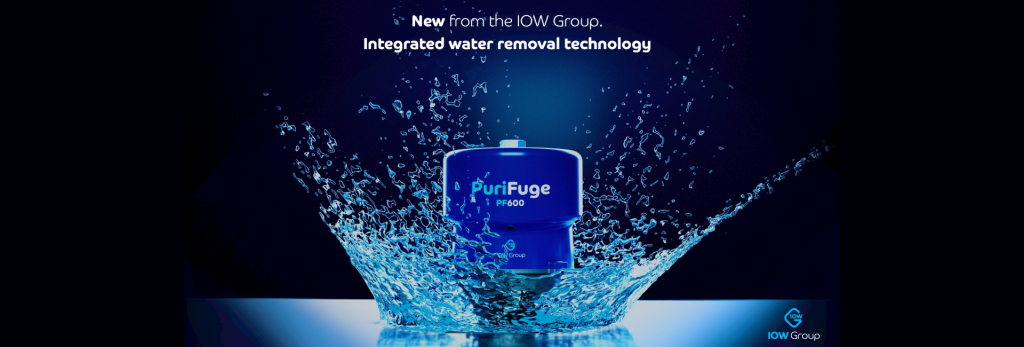
For applications where water contamination is a concern, IOW Group has also developed PuriFuge, a centrifugal filtration system combining solid particle separation with integrated water removal technology.
PuriFuge is designed to remove water contamination from suitable lubricating, hydraulic and diesel oils, helping operators address multiple contamination challenges within a single system. Its automated water removal technology and remote monitoring capabilities provide additional control over the oil cleaning process. This makes PuriFuge a valuable option for applications where both solid particles and water can compromise oil cleanliness and equipment reliability.
Improve Reliability with Cleaner Oil
Maintaining clean mineral oils is an important part of protecting machinery, controlling maintenance costs and reducing avoidable downtime. Centrifugal filtration provides an effective method of removing contamination, helping operators maintain lubricant cleanliness and support longer equipment service life. However, selecting the correct technology is essential. Oil characteristics, contamination levels and operating conditions must all be considered to achieve effective separation.
With advanced centrifugal filtration technology, remote monitoring and solutions for both solid contamination and water removal, IOW Group helps businesses take a more effective approach to oil cleanliness.