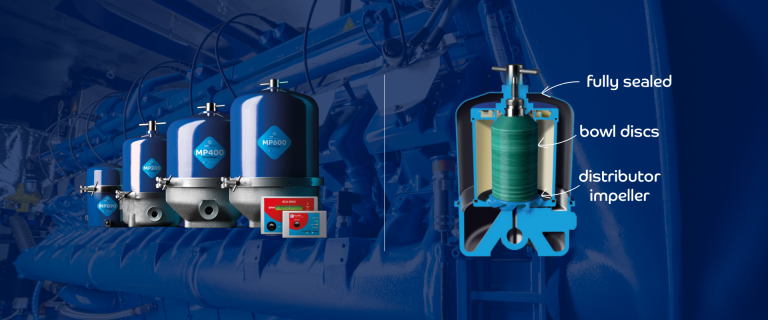
Keeping lubricating oil free from harmful contamination is essential for maintaining engine performance, reducing maintenance costs and protecting valuable machinery. Whether operating marine engines, power generation equipment or industrial machinery, the condition of the lubricating oil can significantly influence equipment reliability.
Although conventional oil filters provide essential protection, some fine contaminants can remain circulating within the lubrication system. Over time, these particles can contribute to increased wear, sludge formation and reduced lubricant effectiveness. Disc-stack centrifugal oil filters offer an advanced approach to oil cleaning, using high-speed rotation and specially designed internal discs to separate harmful particles from lubricating oil. But how does this technology work, and why is it becoming an increasingly valuable addition to modern lubrication systems?
What is a Disc-Stack Centrifugal Oil Filter?
Unlike conventional filters, which rely on filtration media to trap particles, centrifugal filters use differences in density to separate contaminants from the liquid. As oil enters a rapidly rotating bowl, denser particles are driven outwards, where they accumulate for removal during servicing.
Disc-stack technology enhances this process by incorporating a series of conical discs within the centrifuge bowl. These discs create additional separation surfaces, helping fine particles separate from the oil more efficiently. Disc-stack centrifugal oil filters are particularly effective for applications where soot, carbon deposits and fine metallic particles can affect lubricant cleanliness.
How Does Disc-Stack Centrifugal Filtration Work?
Disc-stack centrifugal oil filters operate using the principle of centrifugal separation. In a pressure-driven system, contaminated lubricating oil enters the centrifuge using pressure supplied by the engine’s existing lubrication pump. Alternatively, an external pump may be used where the system requires a separate filtration circuit.
As oil enters the centrifuge, it passes through internal channels before reaching the rotating bowl. This rotation creates centrifugal force, causing denser contaminants to move away from the centre of the bowl. The disc stack improves separation by reducing the distance particles must travel before reaching a collection surface. As contaminants separate, they accumulate within the bowl, while the cleaned oil is directed towards the outlet and returned to the lubrication system. This process continues during operation, helping maintain oil cleanliness without relying on disposable fine-filter cartridges.
Why Is Disc-Stack Technology Important?
Traditional pressure-driven centrifugal oil filters primarily rely on contaminants travelling towards the outer wall of the rotating bowl. Although effective, the distance particles must travel can influence separation performance, particularly when dealing with very fine contamination.
Disc-stack technology addresses this challenge by introducing multiple separation surfaces within the bowl. The closely arranged discs increase the effective settling area and shorten the distance contaminants need to travel. This helps improve separation efficiency and allows the centrifuge to remove fine particles more effectively under suitable operating conditions. For operators managing engines exposed to high levels of soot or sludge, improved contaminant removal can provide valuable protection against contamination-related wear.
How Does Centrifugal Filtration Complement Conventional Oil Filters?
Most engines use full-flow filters to protect critical components from contamination. These filters are designed to process the oil required by the lubrication system while maintaining sufficient flow and pressure. However, because unrestricted oil circulation is essential, conventional filtration media must balance particle removal with acceptable resistance to flow. Consequently, some fine particles may remain suspended in the oil.
Centrifugal oil filters typically operate as bypass systems, processing a proportion of the circulating lubricant independently of the main full-flow filtration route. This allows the centrifuge to target fine contamination while the primary filtration system continues protecting the engine. Centrifugal filtration can also complement automatic backflushing filters, providing an additional method of removing fine particles from lubricating oil. Together, these technologies offer a more comprehensive approach to contamination control.
What Are the Benefits of Disc-Stack Centrifugal Oil Filters?
1. Improved Engine Protection
Fine soot, carbon and metallic particles can contribute to abrasive wear when circulating through lubricated components. Removing these contaminants helps reduce exposure to harmful particles, supporting improved engine protection.
2. Extended Oil Service Life
Effective filtration helps maintain lubricant cleanliness by continuously removing solid contamination. This may support longer oil-change intervals, provided oil analysis confirms that the lubricant remains suitable for continued use.
3. Reduced Maintenance Requirements
Cleaner oil can help reduce contamination-related wear and extend the service life of primary filtration elements. This may lower the frequency of maintenance interventions and reduce expenditure on replacement components.
4. Lower Operating Costs
Reducing lubricant consumption, filter replacements and contamination-related maintenance can contribute to lower total ownership costs. For businesses operating multiple engines or industrial assets, these savings can become particularly valuable.
5. Reduced Environmental Impact
Centrifugal oil filtration does not require disposable fine-filter cartridges within the centrifuge. Instead, collected sludge is removed from the bowl during servicing. Where longer oil service intervals are appropriate, operators may also reduce waste oil disposal and replacement lubricant consumption.
Improve Oil Cleanliness with IOW Group
Maintaining clean lubricating oil is an important part of protecting engines, reducing unnecessary maintenance and improving equipment reliability. Disc-stack centrifugal filtration provides an effective method of removing fine contamination that conventional filtration systems may not capture.
By combining patented bowl disc technology, a sealed centrifuge design and remote monitoring as standard, IOW Group offers an advanced approach to oil cleaning. These features help operators maintain cleaner lubricating oil, make more informed maintenance decisions and reduce contamination-related operating costs.
Looking to improve your oil filtration performance?
Discover how IOW Group’s advanced disc-stack centrifugal oil filters can help protect your engines and machinery.