
Maintaining clean lubricating oil is essential for protecting engines, reducing wear and keeping maintenance costs under control. Whether operating marine engines, power generation equipment or industrial machinery, contamination within the lubrication system can significantly affect reliability and performance.
Centrifugal oil filtration is an established method of removing soot, sludge and other harmful contaminants from lubricating oil. Manufacturers such as Mann+Hummel have supplied centrifugal oil cleaners for many years, providing additional protection alongside conventional full-flow filters. However, centrifugal filtration technology has advanced, offering improved contaminant removal, greater efficiency and smarter maintenance capabilities.
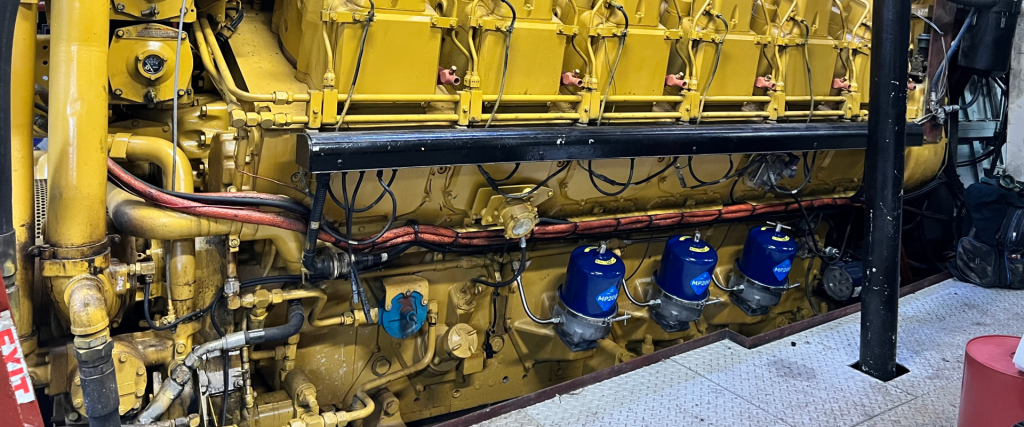
IOW Group centrifugal oil filters incorporate advanced disc-stack technology, a sealed bowl design and remote monitoring as standard, providing an effective upgrade for operators looking to improve oil cleanliness.
So, how do these technologies compare?
How do Mann + Hummel Centrifugal Oil Filters Work?
Mann+Hummel centrifugal oil cleaners use centrifugal force to separate contaminants from lubricating oil. Typically installed as bypass filtration systems, they process a proportion of the engine’s circulating oil rather than the entire lubrication flow. Oil enters the centrifuge under pressure, usually supplied by the engine’s existing oil pump. It travels through a central spindle into the rotor, where it exits through nozzles that generate the force required to spin the bowl. As the rotor accelerates, centrifugal force drives denser contaminants towards its internal wall.
Soot, sludge and other particles accumulate inside the bowl, forming deposits that can be removed during servicing. The processed oil then returns to the engine’s sump, allowing the filtration process to continue. Where sufficient oil pressure is unavailable, an auxiliary pump may be used to operate the centrifuge within a separate filtration circuit.
Why is Centrifugal Oil Filtration Important?
Conventional full-flow oil filters provide essential engine protection, but their design must balance contamination removal with maintaining sufficient oil flow. Because engines require a continuous supply of lubricant, full-flow filters cannot always capture the finest particles without creating excessive restriction. As a result, fine soot, carbon and other contaminants can remain suspended in the oil, potentially contributing to:
-
Increased abrasive wear
-
Changes in oil viscosity
-
Sludge and deposit formation
-
Reduced lubricant performance
-
Shorter primary filter service intervals
-
Increased maintenance requirements
Centrifugal oil filters provide an additional level of protection by separating contaminants according to their relative density rather than relying solely on filtration media. This allows them to target fine contamination that may otherwise continue circulating throughout the lubrication system.
What are the Benefits of Centrifugal Oil Filters?
Effective centrifugal filtration can deliver several operational benefits.
- Improved engine protection: Removing abrasive particles helps reduce contamination circulating around critical engine components.
- Extended oil life: Maintaining cleaner oil can support longer service intervals where oil analysis confirms the lubricant remains suitable for use.
- Reduced maintenance: Lower contamination levels can help reduce unnecessary component wear and extend primary filter service life.
- Lower operating costs: Reduced lubricant consumption, maintenance and contamination-related downtime can contribute to lower ownership costs.
- Improved sustainability: Longer oil service intervals mean less waste oil requiring disposal and potentially lower demand for replacement lubricants.
However, not all centrifugal oil filters deliver the same separation performance. Internal design, rotational speed and monitoring capabilities can significantly influence their effectiveness.
Mann + Hummel vs IOW Group: What's the Difference?
Although both manufacturers use centrifugal force to remove contaminants from lubricating oil, IOW Group has developed additional features designed to improve separation efficiency and simplify maintenance.
1. Advanced Disc-Stack Technology
One of the most significant differences is IOW Group’s patented disc-stack bowl design. Traditional pressure-driven centrifuges rely on contaminants travelling towards the outer wall of the rotating bowl. IOW Group incorporates a series of discs within the centrifuge, increasing the surface area available for separation and reducing the distance particles must travel before being collected.
This helps improve the efficiency of contaminant removal, allowing more soot and sludge to be separated from lubricating oil under suitable operating conditions.
2. Improved Contaminant Removal
Filtration performance is an important consideration when comparing centrifugal oil cleaners. In a three-hour comparative test reported by IOW Group and witnessed by Lloyd’s, IOW Group’s centrifugal filtration technology removed 35% more solids than the Mann+Hummel unit tested. Since then, IOW Group has continued developing its centrifugal filtration technology, with further comparative testing demonstrating improvements in sludge removal.
These results highlight the importance of assessing actual filtration performance rather than assuming all pressure-driven centrifuges offer equivalent cleaning capabilities. Results will vary depending on the models compared, oil condition, operating pressure and application.
3. Sealed Bowl Design
IOW Group centrifugal oil filters feature a sealed bowl designed to help prevent collected contamination from re-entering the lubrication system during servicing. As soot and sludge accumulate, they remain contained within the bowl until maintenance is required. This design supports cleaner servicing and helps minimise the risk of disturbing accumulated contamination when removing the bowl.
4. Remote Monitoring as Standard
IOW Group centrifugal oil filters incorporate remote monitoring technology, giving operators greater visibility of filtration performance. The monitoring system tracks centrifuge RPM, helping engineers identify changes in operation. As contamination builds inside the bowl, rotational speed can decrease, indicating that servicing may be required. This reduces reliance on fixed maintenance intervals and helps operators make more informed servicing decisions. For businesses managing multiple engines, remote monitoring can be particularly valuable in improving maintenance planning.
Can You Replace a Mann + Hummel Centrifuge with an IOW Group Filter?
Upgrading an existing centrifugal filtration system is easier than expected. IOW Group centrifugal oil filters are designed with retrofit applications in mind, and many models feature compatible mounting arrangements, inlet connections and fixing positions. This bolt-on, bolt-off approach can allow existing centrifugal oil cleaners to be replaced without extensive modifications.
However, compatibility should always be confirmed against the existing filter and lubrication system. Operating pressure, oil flow, sump capacity and return arrangements must also be considered to ensure effective operation without compromising engine lubrication.
Why Choose IOW Group Centrifugal Oil Filters?
IOW Group’s centrifugal filtration technology has been developed to provide enhanced oil cleaning while making maintenance easier and more predictable. Their range includes the MP090, MP200, MP400 and MP600, offering solutions for different engine/machine sizes and applications.
Key features include:
- Patented disc-stack technology for improved contaminant separation
- High-speed centrifugal operation for effective soot removal
- Sealed bowl design to eliminate cross contamination
- Straightforward retrofit
Suitable for marine, power generation, mining, transport and industrial applications, IOW Group centrifugal filters help operators maintain cleaner lubricating oil and protect valuable machinery.
Is It Time to Upgrade Your Centrifugal Oil Filter?
Mann+Hummel centrifugal oil cleaners have long provided an established method of removing contamination from lubricating oil. However, advances in filtration technology mean operators now have opportunities to improve oil cleaning performance without necessarily making significant changes to their existing lubrication systems.
IOW Group’s disc-stack technology, sealed bowl and remote monitoring provide additional capabilities for businesses looking to upgrade their centrifugal oil filtration. By reducing the amount of soot and sludge circulating through the engine, effective centrifugal filtration can help maintain lubricant cleanliness, protect critical components and reduce contamination-related maintenance.
Discover how IOW Group’s advanced centrifugal oil filters could improve your filtration system.